10th Class Mathematics Trigonometric Function Trigonometry
Systems of Measurement of an Angle
Circular System
In this system, the angle is measured in radians.
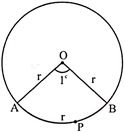
Radian: The angle subtended by an arc length APB equal to the radius of a circle at its centre is defined of one radian (see figure). It is written as \[{{1}^{c}}\]. (‘c’ denotes radian)
Relation between the Units
Look at the circle in the above figure and note that,
\[360{}^\circ =2{{\pi }^{c}}\Rightarrow 90{}^\circ =\frac{{{\pi }^{c}}}{2}\] and \[45{}^\circ =\frac{{{\pi }^{c}}}{4}\]; Or, simply, \[90{}^\circ =\frac{\pi }{2},45{}^\circ =\frac{\pi }{4}\]
For convenience, the above relation can be written as, \[\frac{D}{90}=\frac{R}{\frac{\pi }{2}}\], where, D denotes degrees, and R radians.
Remember
- \[1{}^\circ =\frac{\pi }{180}\] radian \[=0.0175\] radians (approximately).
- \[1{}^\circ =\frac{180}{\pi }\] degrees \[=57{}^\circ 17'44''\] (approximately).
- \[30{}^\circ =\frac{\pi }{6},45{}^\circ =\frac{\pi }{4};60{}^\circ =\frac{\pi }{3};90{}^\circ =\frac{\pi }{2};120{}^\circ =\frac{2\pi }{3},180{}^\circ =\pi \]
Note: If no unit of measurement is shown for any angle, it is considered as radian.
Trigonometric Ratios
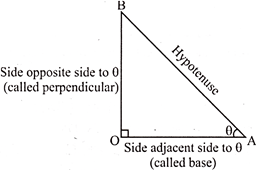
Let AOB be a right triangle with \[\angle AOB\] as \[90{}^\circ \]. Let \[\angle OAB\]be \[\theta \]. Notice that \[0{}^\circ <9<90{}^\circ \]. That is, \[\theta \] is an acute angle (see adjacent figure).
Six possible ratios among the three sides of the triangle AOB, are possible. They are called trigonometric ratios.
- Sine of the angle \[\theta \] or, simply \[\text{sin}\theta \]: \[\sin \theta =\frac{Perpendicular}{Hypotenuse}=\frac{p}{h}=\frac{OB}{AB}\]
- Cosine of the angle \[\theta \] or, simply \[\cos \theta \]: \[\cos \theta =\frac{Base}{Hypotenuse}=\frac{b}{h}=\frac{OA}{AB}\].
- Tangent of the angle \[\theta \] or, simply \[tan\theta \]: \[\tan \theta =\frac{perpendicular}{base}=\frac{p}{b}=\frac{OB}{OA}\]
- Cotangent of the angle \[\theta \] or, simply \[\cot \,\theta \]: \[\cot \theta =\frac{base}{perpendicular}=\frac{b}{p}=\frac{OA}{OB}\]
- Cosecant of the angle \[\theta \] or, simply \[cosec\theta \]: \[co\sec \,\,\theta =\frac{hypetenuse}{perpendicular}=\frac{h}{p}=\frac{AB}{OB}\]
- Secant of the angle \[\theta \] or, simply \[sec\theta \]: \[\sec \,\,\theta =\frac{h}{b}=\frac{AB}{OB}\]
We observe that,
- \[\cos ec\,\theta =\frac{1}{\sin \,\theta },\sec \,\theta =\frac{1}{\cos \,\theta }\] and \[\cot \,\theta =\frac{1}{\tan \,\theta }\];
- Also, \[\tan \,\theta =\frac{\sin \,\theta }{\cos \,\theta }=\left( \frac{p/h}{b/h} \right)\] and \[co\operatorname{t}\,\theta =\frac{\cos \,\theta }{\sin \,\theta }=\left( \frac{b/h}{p/h} \right)\]
PYTHAGOREAN TRIPLETS
Pythagorean Triplets are basically sides of a right A which obey Pythagoras theorem.
Examples are:
- 3, 4, 5 (and all their multiples in the form of 3k, 4k, 5k etc. for eg. 6, 8, 19 & etc.)
- 8, 15, 17 (and all their multiples in the form of 8k, 15k, 17k etc.)
- 9, 49, 41 (and all their multiples in the form of 9k, 49k, 41k etc.)
- 1, 2. 4, 2.6 (and all their multiples in the form of 1k, 2.4k, 2.6k etc.)
- 5, 12, 13 (and all their multiples in the form of 5k, 12k, 13k etc.)
- 7, 24, 25 (and all their multiples in the form of 7k, 24k, 25k etc.)
Example: If \[\cos \theta =\frac{2}{5}\], then find the values of \[\tan \,\theta ,\cos ec\,\theta .\]
Solution:
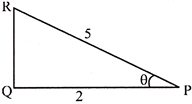
Given, \[\cos .\theta =\frac{2}{5}\]
Let PQR be the right triangle such that \[\angle QPR=\theta \] (see figure)
Assume that \[PQ=2\] and \[PR=5\].
Then, \[QR=\sqrt{P{{R}^{2}}-P{{Q}^{2}}}=\sqrt{25-4}=\sqrt{21}\]
So, \[\tan \,\theta =\frac{Opposite\,\,side\,\,to\,\,\angle \theta }{base}=\frac{QR}{PQ}=\frac{\sqrt{21}}{2}\] and \[\cos ec\,\theta =\frac{Hypotenuse}{perpendicular}=\frac{PR}{QR}=\frac{5}{\sqrt{21}}\]
Trigonometric Identities
- \[{{\sin }^{2}}\theta +{{\cos }^{2}}\theta =1\]
- \[{{\sec }^{2}}\theta -{{\tan }^{2}}\theta =1\]
- \[cose{{c}^{2}}\theta -{{\cot }^{2}}\theta =1\]
- \[\sin (90-\theta )=cos\theta ;\,\,\,\,cos(90-\theta )=sin\theta \]
- \[\sec (90-\theta )=cosec\theta ;\,\,\,\,cosec(90-\theta )=\sec \theta \]
- \[ten(90-\theta )=cot\theta ;\,\,\,\,cot(90-\theta )=ten\theta \]
Value of Trigonometric Ratios for Specific Angles
Trigonometric Ratios
|
Angles
| ||||
\[0{}^\circ \]
|
\[30{}^\circ =\frac{\pi }{6}\]
|
\[45{}^\circ =\frac{\pi }{6}\]
|
\[60{}^\circ =\frac{\pi }{3}\]
|
\[90{}^\circ =\frac{\pi }{2}\]
| |
\[\sin \theta \]
|
\[0\]
|
\[\frac{1}{2}\]
|
\[\frac{1}{\sqrt{2}}\]
|
\[\frac{\sqrt{3}}{2}\]
|
\[1\]
|
\[\cos \theta \]
|
\[1\]
|
\[\frac{\sqrt{3}}{2}\]
|
\[\frac{1}{\sqrt{2}}\]
|
\[\frac{1}{2}\]
|
\[0\]
|
\[\tan \theta \]
|
\[0\]
|
\[\frac{1}{\sqrt{3}}\]
|
\[1\]
|
\[\sqrt{3}\]
|
\[\infty \]
|
\[\cos ec\theta \]
|
\[\infty \]
|
\[2\]
|
\[\sqrt{2}\]
|
\[\frac{2}{\sqrt{3}}\]
|
\[1\]
|
\[\sec \theta \]
|
\[1\]
|
\[\frac{2}{\sqrt{3}}\]
|
\[\sqrt{2}\]
|
\[2\]
|
\[\infty \]
|
\[cot\theta \]
|
\[\infty \]
|
\[\sqrt{3}\]
|
\[1\]
|
\[\frac{1}{\sqrt{3}}\]
|
\[0\]
|
Note:
- For \[\theta =\frac{\pi }{4}\] (or \[45{}^\circ \]) \[sin\theta =cos\theta ,tan\theta =cot\theta \]and \[sec\theta =cosec\theta \].
- \[\sin \theta \] and \[tan\theta \] are increasing functions in \[0{}^\circ \le \theta \le 90{}^\circ \] {or \[\theta \in [0,\frac{\pi }{2}]\]}.
Graphically it is shown as,
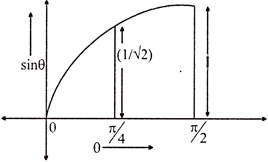
Graph of \[y=\sin \,\theta \] in \[\theta \,\in [0,\pi /2]\]
- \[\cos \,\theta \] is a decreasing function in \[0{}^\circ \le \theta \le 90{}^\circ \] {or \[\theta \in [0,\frac{\pi }{2}]\]}
Graphically, it is shown as,
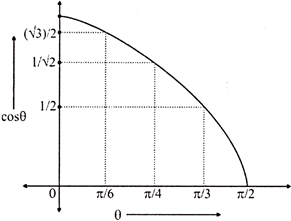
Graph of \[y=\cos \theta \] in \[\theta \in \left[ 0,\frac{\pi }{2} \right]\]


Comments
Post a Comment